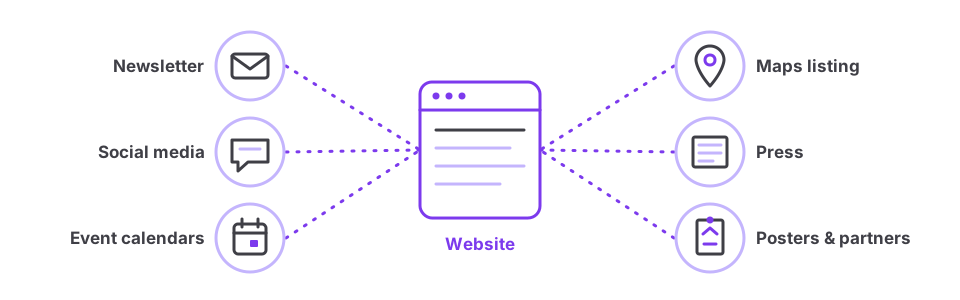
The Website as a Hub: CMS and Integrated Communication for Dance Organizations
Dance and cultural organizations communicate on many channels at once: the website, a newsletter, one or two social media accounts, messenger groups, event directories, a maps listing, posters, sometimes the local press. Each channel needs dates, texts and photos. Without a plan, the same information is typed again and again – and sooner or later the channels contradict each other.
The idea: one source, many channels
The simplest working model is to treat the website as the reference point. Everything important is published there first – the schedule, events, prices, teachers, contact – and the other channels point to it or reuse it. The content management system (CMS) is the tool that keeps this source current. (Which CMS fits: Choosing a CMS.)
Why the website and not social media? Because you control it, it can be found in search engines and AI assistants, it does not depend on an algorithm, and it is still there when a platform changes its rules.
The channels and their roles
| Channel | Role | Tip |
|---|---|---|
| Website | Reference for all facts: schedule, events, prices, people, contact | Keep event details as text on the page, with full address and times |
| Newsletter | Reaches people who already know you; reliable for announcements | Short, regular, with links back to the event pages |
| Social media | Atmosphere, photos, short reminders, community | Link to the website for details instead of repeating everything |
| Messenger groups | Quick updates for regulars (last-minute changes) | Use for changes, not as the only place where dates exist |
| Event directories and calendars | Reach dancers who are looking for something to do, including travellers | Enter the same title, date and venue as on your website |
| Maps listing | Found by people searching nearby; shows address and opening times | Keep name, address and times identical to the website |
| Local press and city calendars | Visibility beyond the dance community | Send a short text with date, place, one good photo and a contact |
| Partners (venues, other schools, tourist offices, cultural centres) | Shared audiences, cross-promotion | Agree on who announces what and link to each other’s pages |
| Print (posters, flyers) | Local presence in venues and shops | Add the website address or a QR code to the event page |
A simple weekly routine
- Update the website first: new events, changes, removed past dates.
- Send or schedule reminders on social media and in messenger groups, linking to the event page.
- Check listings: event directories and the maps entry match the website.
- Once a month: newsletter with the coming highlights.
- Before big events: press note and partner announcements, four to six weeks ahead.
Consistency is the real goal
Dancers, search engines and AI assistants all reward the same thing: the same correct information everywhere. A milonga that starts at 21:00 on the website, 21:30 on social media and is missing from the directory creates confusion and lost visitors. A good CMS, a clear reference point and a short routine fix most of this.
Where AI tools can help with this work – and where not: AI tools for dance and cultural organizations.