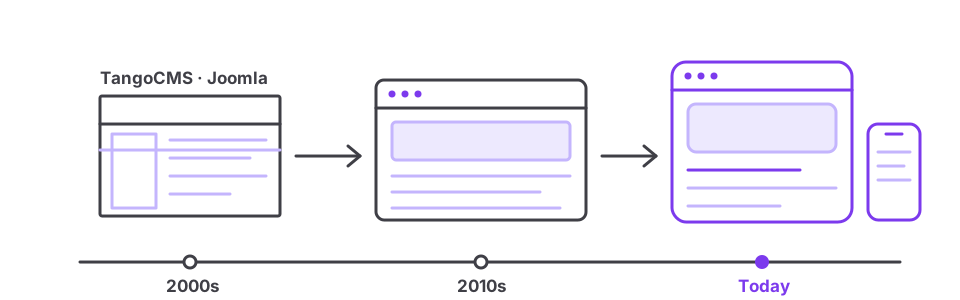
Content Management Systems Then and Now: From TangoCMS to Today's Options
A content management system (CMS) is the software that lets people edit a website without writing code: log in, change a text, upload a photo, publish. For dance schools, clubs and cultural associations, the CMS decides whether the website stays current or slowly goes stale.
The 2000s: the open-source PHP boom
In the early 2000s, cheap web hosting with PHP and MySQL made it possible for anyone to install a CMS. A whole generation of free, open-source systems appeared:
- Drupal (first released 2001) – powerful and flexible, popular with universities and larger organizations.
- WordPress (2003) – started as blogging software and grew into a general website system.
- Joomla (2005, a continuation of the earlier Mambo project) – widely used for club and association websites.
- Dozens of smaller systems written by individuals or small volunteer teams. TangoCMS, developed on this domain between 2007 and 2013, was one of them: lightweight, built on its own framework, with regular releases and its own security advisories.
For a small organization the typical setup was: a volunteer with some technical interest installs a CMS on shared hosting, picks a theme, and the board or teachers update news and dates. It worked – as long as that volunteer stayed.
Why many systems disappeared
Most of the smaller systems did not survive. The reasons were similar:
- Volunteer time ran out. Maintaining a CMS means constant security fixes and compatibility updates. TangoCMS ended in 2013 for exactly this reason, as its farewell notice explains.
- Network effects. The more people used WordPress, the more themes, plugins, tutorials and helpers existed for it – which attracted even more users.
- Changing technology. New PHP versions, the shift to smartphones and the need for secure connections (HTTPS) forced large rewrites that small projects could not afford.
Websites that kept running on an abandoned system became a risk. Many old club websites from that era were eventually hacked, abandoned or rebuilt from scratch.
Today: three main routes
Today the choice for a small organization usually comes down to three routes:
| Route | What it is | Typical users |
|---|---|---|
| Hosted website builders | You rent a ready-made platform and edit pages in the browser; hosting, updates and security are included | Small schools and groups without technical help |
| WordPress and other maintained open-source systems | You (or a helper) install and maintain the system; huge choice of themes and plugins | Organizations that want flexibility or already have WordPress know-how |
| Static sites | Pages are generated once and served as simple files; edited as text files or through a light editing interface | Small sites that change rarely and value speed, security and low cost |
Alongside the website, many dance schools now use specialized booking or studio software for class registration, payments and passes. The website then links to it rather than doing everything itself.
What has not changed
The core problem is the same as twenty years ago: someone has to keep the content current. The best system is the one that the person responsible actually finds easy to use – and that will still receive security updates in five years.
How to decide for your own organization: Choosing a CMS for a dance school or cultural organization.